Overview
This is meant to be an introductory effort to some of the Āyurvedic principles that underlie the science. Learning this takes time and experimentation. You need to see for yourself how these principles work within your body.
The overview is this: the world is made up of 5 elements: space, air, fire, water and earth. This means everything, including us. These elements have a set of qualities or characteristics about them. Most of these characteristics make sense and others take some time to understand (see the chart below).
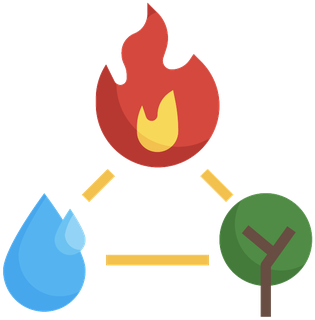
These elements can then combine and so, the characteristics combine as well and create something new. Space and air combine to create Vata. Fire and water combine to create Pitta. Water and earth combine to create Kapha. These “bio energies,” based on their qualities and characteristics, have different jobs to do in the body. Vata is all about movement, is deeply connected to the nervous system and the colon. Pitta is all about transformation, any transformation in the body, so it is deeply connected to digestion on the gut level but also on the cellular level. Its major location is in the intestines. Kapha is all about stability and strength of immunity. Its major locations are in the chest and the low back.
These 3 “doṣas” exist all through the body and they each have jobs to do. We are made up of a unique combination of the 3 doṣas. Whatever that ratio is, is our “normal.” The “normal” is never a single point. It is usually a range of normal. The body will ebb and flow as we age, as we go through a day, or a season. If we understand our “normal range” we will come to know when we start to go beyond the edge of our range. If we go beyond our normal range, say, by eating large portions regularly or consuming foods that just don't get digested properly, the systems of the body have to work harder. Improperly digested food makes its way through the system and can't be properly utilized but has to be dealt with in some way. This will eventually lead to disease over time.
So, basically, when the doṣas are working as they are supposed to, all is good. If the doṣas get out of balance, they can wreak havoc in the body if not brought back into their normal range.
Qualities & characteristics
These are the key to everything. As you begin to memorize these and see them expressed in the weather, the season, the food and yourself, you are then beginning to understand Āyurveda.
| Heavy | ⟷ | Light |
| Slow | ⟷ | Sharp |
| Cold | ⟷ | Hot |
| Oily | ⟷ | Dry |
| Smooth | ⟷ | Rough |
| Viscid | ⟷ | Hard |
| Stable | ⟷ | Liquid |
| Subtle | ⟷ | Gross |
| Soft | ⟷ | Hard |
| Clear | ⟷ | Cloudy |
The doṣas
The observable qualities and characteristics of the doṣas are:
- Vata – dry, light, cold, rough, subtle, and mobile
- Pitta – somewhat oily, light, sharp, hot, mobile, liquid, and a peculiar unripe odor
- Kapha – oily, cold, heavy, slow, smooth, steady, and an earthy odor
As in the assignment of these qualities according to doṣa, each kind of food bears such qualities as per the organic continuity of co-evolving natural counterparts. These qualities obviously have a direct effect on the emotions or moods and how the body digests a particular food. One can easily become irritable after eating hot (chili) food.
Like increases like
When the qualities of food are similar to the qualities of a doṣa, ingestion will tend to aggravate the doṣa. Likewise, opposing qualities of food will tend to pacify the doṣa. Such a basic understanding is therefore helpful in developing a cooking strategy which will be pacifying and not provoking to the mind-body doṣa constitution.
Opposites decrease
When you start to learn when you are “off balance,” “not your usual self,” you'll start to notice what qualities seem excessive or depleted. A simple example is if you are feeling heavy (we are not talking weight necessarily) or feeling too light and airy, you can often find that eating foods or doing activities that are opposite will help bring you back to your normal range.
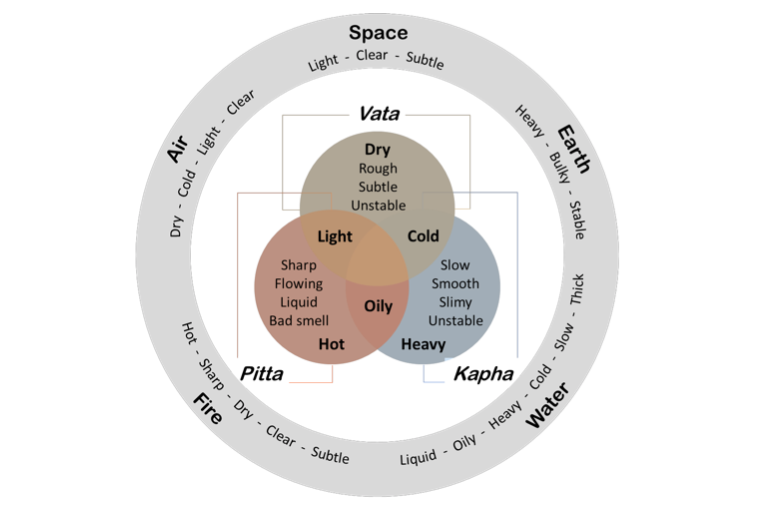
The chart above is a great tool because it shows the elements on the outer circle, the qualities and characteristics just above the elements, and then the Doṣa is presented with the intersecting circles identifying their qualities AND the intersecting circles show what 1 quality is shared between them.
- Light – sprouts, popcorn
- Heavy – whole beans, cheese
- Slow – yogurt (curd)
- Sharp – garlic, onion
- Cold – mint, melon
- Hot – chili pepper, black pepper
- Oily – coconut, avocado
- Dry – rye, millet
- Stable – ghee
- Mobile – alcohol, sprouts
Choosing the right combination of food groups and cooking them optimally to retain their high prânic vibration is nourishing when all six tastes are also balanced. The art of Āyurvedic cooking is incomplete without the effort to balance the tastes while preparing a wholesome meal. Often it is only possible to bring about the balance through different items of the meal menu eaten in an order. This is done to retain the flavour and texture of a particular dish. Such an effort to balance the tastes is also a common strategy. The order in which the individual savoury or sweet dish is served or ingested is then adjusted to increase digestion and promote sumptuousness.
Digestion
The food we eat is one of the prime influences on our state of health and we have good influence over our food choices. Āyurvedic tenets proclaim that “disease is a result of assault against one's own intelligence.” Though certain ailments do occur without being self-inflicted in this lifetime, many are the result of making poor or misinformed food choices. We have to face the consequences of those choices sooner or later.
Āyurvedic dietetics focuses heavily on the strength of the digestive fire which determines the digestive capacity of the eater. There are principle tendencies based on the triple doṣa constitution. Associated with Vata is the irregular metabolism. Pitta is more associated with a hyper-metabolism. Associated with Kapha is the hypo-metabolism. Whereas the balanced kind favors a balanced metabolism.
The quantity of food that is being properly digested and assimilated into the bodily tissues, and what is excreted are given special importance. You are what you digest! These variables differ with individual constitutions, digestive power, moods and feelings, diurnal and seasonal rhythms among other lesser influences (such as cleanliness, ambience during eating, etc.).
Āyurvedic culinary art is unique due to its emphasis on balancing ingredients and spices in a way to achieve optimal digestibility with a diet adapted to direction or locale and time of month and day, etc. The satiating potency and pranic food value are based upon the singular axiom that the whole is much greater than the sum of its parts, just like the wholeness of the body itself. Therefore, cooked food must be much more than the sum of its ingredients.
Cooking is an art. Āyurvedic cooking is the art of balancing ingredients while inducing prana (life-force or energy). Most importantly, all six tastes are balanced during the cooking. Āyurveda recommends light cooking under controlled heat using heavy nonreactive pots and pans. In order to preserve prana, overheating and losing the original color and nascent taste of the vegetable is not recommended. The cooked food needs to exude light and be full of energy (prana) with the vegetables retaining some of their original freshness. For example, the okra needs to be radiant green and not dripping with oil or the broccoli needs to be bright green and still somewhat crunchy!
The modern science of dietetics is somewhat lopsided because of its focus on the class of nutrients based on the quantities of calories, fats, proteins, carbohydrates, etc. There is little or no reference to the seasonal rhythms, geographic location of where the food is grown, digestive capacity of the individual, biorhythms of the eater and other holistic factors. The reductionistic approach is not practical for the consumer, to say the least. Moreover, modern dietary advice is diverse and sometimes contradictory. With confusing notions, it is hard to know what to eat and what not to eat. Food has also become like fashion with changing food fads based on commercially hyped trends. In addition, we can become disconnected from fresh (high prânic) food and resort to eating processed or packaged convenience foods. Ingredients in cooking that come from heirloom varieties, maintaining the organic continuity of their lifeforce, are not worth compromising. The time-honoured wisdom of Āyurveda provides a secure traditional platform in the field of nutrition and health to guide towards a spiritual, mindful lifestyle.
Suggestions
Remember, these suggestions are based on how you are feeling at the moment or if you know you are trying to address a specific issue. Doing any of these suggestions for no reason or trying all of them at once is probably not in your best interest and will not yield a positive outcome for you.
To increase your digestive fire: If you don't usually feel hungry. If you typically have good digestion but are going to eat a heavy meal. If you've had a cold or been a little low energy. Dipana = increases digestive fire. Pacana = cooks food better and is good for getting rid of the build up in the GIT.
Ginger pickle
Remove skin from ginger and slice it thin. Put the slices in a little container and put real lemon juice (no lemon oil or fake lemon) on them. Add a pinch of salt. 30 minutes before a meal, take one and chew on it. Swallow the juices. You can eventually spit out the ginger.
- Notice how you feel as you prepare to have your meal
- Notice how you feel directly after your meal
- Notice how you feel a few hours after your meal
- IF you notice that you don't feel good, this tells us something, too. Maybe you took too much OR you took the ginger but then didn't eat OR you just don't need the ginger to stimulate anything; the digestive fire is fine and you actually aggravated it a little.
Black pepper
This is for people who don't do well with spices. It's not as potent as ginger so the effects will be slower, but it does Dipana/Pacana. IF you have a slow/sluggish digestion use black pepper liberally.
Amla candy
This is actually very high in Vit. C! And it can help with metabolism and support the downward movement of vāta. And they are a yummy snack!
Warm water
Hot boiled water is also very good at Dipana/Pacana. Boil water in an open pot (so steam and impurities can escape). Let the water boil for 3–5 minutes. Let it cool til it's a temp that is good for you. Warmer is typically better.
- It stimulates digestion and can stimulate a bowel movement
- Drink the water, 6–8 oz is fine, first thing in the morning
- Hot boiled water can be sipped on throughout the day
How to modify your cooking for doṣas and agni
To balance vata
- The best oils are ghee, sunflower or sesame. Use plenty.
- Use warming spices (cinnamon, cumin, fresh ginger, asafoetida).
- Choose heartier grains, such as barley and brown rice, or mix white rice with another grain.
- Avoid cooling foods, such as coconut oil and maple syrup, and drying grains (quinoa, corn, millet).
To balance kapha
- Use less oil overall. Ghee, mustard oil, olive oil and sunflower oil are best.
- Use warming, invigorating spices (cinnamon, black pepper, rosemary).
- Serve lighter and drier grains, such as buckwheat, quinoa or millet.
- Choose more pungent tastes, such as bok choy, broccoli and Brussels sprouts.
- Select lighter augmenting vegetables, such as zucchini, cucumber or carrot.
- Use moderate amounts of salt cooked into food.
- Minimize dairy.
To balance pitta
- The best oils are ghee, sunflower or coconut oil.
- Focus on neutral or cooling spices (coriander, cardamom, saffron, cilantro, mint).
- Reduce the amounts of pungent, warming spices by 10–50%, depending on your state of imbalance.
- Choose grains that are sweet and moderately heavy (oats, barley, white rice).
- Avoid pungent or warming foods, such as black pepper, moringa, honey or arugula.
To balance agni
- Ghee is best when agni is compromised.
- Use moderate amounts of spices cooked into all dishes. Be sure to include mineral salt and ginger.
- All-in-one dishes, such as kitchadi, restore agni the fastest.
- Choose grains and legumes that are easier to digest, such as white rice and split mung.
- Have moderate sized meals, with not too much or too little of any one thing.
- Include all six tastes in a meal.
- Leave out snacking between meals, and avoid tasting when you are preparing food.
Āyurvedic guidelines
- If you eat snacks in between meals, try stopping and/or cut back for 2 weeks and notice how you feel – this is a form of a diagnostic test. Stopping snacks often does the trick for cleaning up some digestive issues.
- Eat the biggest meal of your day at noon time as often as you can – have a hot, cooked meal; eat lighter in quantity at the evening meal – this is in line with Nature and the timeframes of the doṣa. This highlights a key teaching: quantity is the most important aspect in Āyurveda. If you are eating heavy foods, eat less of it. If they are lighter, you can eat more.
- Only eat a snack if you are really in need of something to tide you over – SOME people do need a snack due to their digestive system being more quick.
- If you find you need a snack regularly to tide you over, you need to examine your breakfast and lunch options and experiences – are you skipping lunch all together? No breakfast and no lunch, but you feel hungry? These clues help in figuring things out.
- Prepare your food as freshly as you can – maybe that's only when you are home on the weekends. Fresh prepared is truly the best in terms of nutrients and prana (lifeforce). As you heat and reheat, or freeze – these processes break down foods more and can deplete their nutrient worth. Basic rule – do what you can do and try to increase it.
- If you leave home for work, try to bring hot food for your lunch.
- If you notice that something you've eaten regularly over your life is no longer working for you – stop eating it for a bit. Similar to #1, it's a test. What do you notice? No change – try one more week. If not, it's likely not the culprit. A little change – likely part of the issue. Big change – you nailed it – take a longer break and then reintroduce at some point in a moderate level.
- If you notice you are feeling heavy and not hungry – try having a simple, simple veggie broth soup with some veggies and/or a meat broth soup with a little meat and veggies for several days – when you feel digestive power restored, take a break from that and be more choosy about foods you eat so as not to build up that heaviness. This speaks to the guṇas – light increases lightness, it reduces heaviness.
- It's not about eating light, light, light all the time or vice versa.
- Having said that – quantity is a quick guide: keep the quantity of the heavier foods lower and quantity of lighter foods higher.
- Having said that – it's all in relation to your experience and your gut – not what your spouse/partner can eat or what someone else says.
- Do not drink cold water regularly. Do not drink lots of water/liquids during meal times (sipping is fine); do not drink a lot of water just before or just after a meal. Get used to warm to hot water to sip on through the day, which has a better effect than room temp water.
- Some of us have a digestion that is slower, taking 5–6 hours to fully digest.
- Some of us have a digestion that is quick and sharp, taking 2–3 hours to digest.
- Some of us have a digestion that flip flops between the two.
- Some of us have a digestion that is close to balanced – 3–4 hours to digest.
- If you experience regular gas, regular bloating, regular discomfort, regular gurgling – these are not signs of good digestion. Just sayin'.
- Eat fresh as much as possible for as long as possible (especially for our seasons!). This is about the energy in the food. Food is LIFE energy. The more local it is, the better, even over imported organic.
- Start noticing the seasons and the characteristics you see – then notice if you have the same characteristics.
- Do not hold back on any of the natural urges that come up for you. The suppression of these urges, over time, can lead to serious illness. Seriously.
- If you still have digestive issues after making a valiant effort with 1–14, then perhaps you want to work with an Āyurvedic practitioner to help pinpoint what the culprit is and how to approach it from an Āyurvedic perspective.
In closing, I'd like to thank you for coming on this Āyurveda journey. Know that you will most likely not become an expert or implement everything right away.
Remember that we “digest” on many levels. Learning and implementing Āyurveda is very much like practicing yoga. You must learn the foundations of yoga first. You learn with your mind but then the teachings seep into your body and bones and psyche. The same for Āyurveda!
Come back to the materials as often as needed. You'll discover new information you glossed over before. You'll forget things and remember them again.
Āyurveda is a journey back to your self.
Enjoy your journey!
Feel free to reach out to me with questions or puzzlements.

Linda Rowe, Doctor of Āyurveda
Lindāyurveda
lindayurveda.com/contact
linda@lindayurveda.com
(207) 551-4055
Facebook · YouTube